
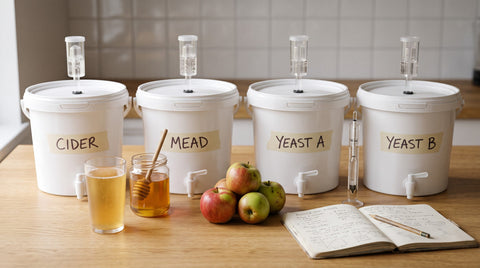
Five litres is the most underrated size in homebrewing. It is cheap enough to try a recipe you're not sure about, small enough to finish in a few weeks, and light enough to carry full. It is also the classic size for cider and mead, and the size we use ourselves for yeast and hop trials before we commit a full batch.
Here is how to get the most out of a 5 L fermenter, with three simple starting points: a supermarket cider, a traditional mead and a beer test batch.
What you need
- Fermentation Bucket 5 L with lid, tap and airlock. It also comes in packs of 2, 5 and 10 if you want to run trials side by side.
- Mini Hydrometer and a 50 ml measuring cylinder, so a gravity reading costs you 50 ml instead of a full glass.
- A yeast that suits the job: Lalvin EC-1118 for dry, clean cider and mead, SafCider AB-1 for a rounder cider, Lalvin 71B or Mangrove Jack's M05 for mead.
- Chemipro OXI 100 g to clean and sanitise everything that touches the juice.
- Bottle Filler for Tap to bottle straight from the bucket.
Starting from zero? The Cider & Mead First Brew Kit puts the bucket, mini hydrometer, measuring cylinder, EC-1118 and OXI in one box. All our kits are in Starter Kits.
1. Cider from supermarket apple juice
The easiest first ferment there is. Buy 4.5 L of 100% apple juice and check the label: added vitamin C is fine, but preservatives such as potassium sorbate (E202) or sodium benzoate (E211) will stop the yeast, so skip those cartons.
- Clean and sanitise the bucket, lid, tap and airlock with OXI.
- Pour in the juice and take a gravity reading. Most apple juice starts around 1.045–1.050, which ferments to roughly 5.5–6.5% ABV.
- Sprinkle in the yeast (one sachet is plenty for 5 L), fit the lid and half-fill the airlock with sanitiser.
- Keep it at 15–20 °C. Cooler is slower but cleaner.
- It's done when the gravity stays the same for three days, usually somewhere between 0.995 and 1.000 after one to three weeks.
EC-1118 gives a dry, crisp, wine-like cider; AB-1 keeps more apple character. Drink it still, or bottle it with priming sugar for a sparkling cider.
2. A traditional mead
Mead is just honey, water and yeast, but it rewards patience. Dissolve 1.3–1.5 kg of honey in lukewarm water and top up to about 4.5 L. That gives a starting gravity around 1.090–1.100, enough for a mead of roughly 12–13% once it ferments dry.
- Honey has almost no nitrogen, so the yeast needs help: add yeast nutrient in two or three small doses over the first week.
- Stir gently once a day for the first few days to release CO₂.
- Ferment at 16–20 °C with 71B or M05. 71B softens the acidity and keeps it fruity; EC-1118 ferments drier and handles higher strength.
- After three to six weeks, when the gravity stops moving, move it off the sediment into a 5 L demijohn to clear and age. Two to six months makes a big difference.
3. Beer test batches
This is where 5 L buckets really earn their place. Brew a normal batch, then split it over several buckets to answer a question with your own palate:
- Yeast trial: the same wort with four different yeasts, side by side, same temperature.
- Dry hop trial: one hop per bucket to learn what each one really tastes like in your beer.
- Recipe trial: brew a 5 L version of a new recipe before you commit 20 L of malt and hops to it.
For beer, fill to about 4–4.5 L: an ale throws a thick head of foam and needs the room. Keep the buckets together so they share the same temperature, otherwise you are testing your room, not your yeast.
Measuring small batches
A standard hydrometer jar swallows 100–250 ml, which is a real share of a 5 L batch. A mini hydrometer in a 50 ml cylinder gives the same reading for a fraction of the beer. Take one reading when you pitch and two or three near the end; if two readings three days apart match, fermentation is finished.
Bottling
A 5 L batch fills about a dozen 33 cl bottles. Clip the bottle filler on the tap, let the first splash run off with the sediment, then fill. For sparkling cider or beer, add priming sugar; our guide Bottle Conditioning Done Right covers the amounts and timing. Only prime a cider or mead that has fully fermented, or the bottles will over-carbonate.
Keep track of every trial
Small batches only teach you something if you write down what you did. Log the recipe, the yeast, every gravity reading and your tasting notes in CraftBrew.io, our brewing app, so you can compare trials side by side and scale the winner up to a full batch.
For clubs, workshops and classrooms
Running a brew club evening, a fermentation workshop or a school project? The 5 L bucket also comes in a 5-pack or a box of 10, the cheapest way to give everyone their own fermenter. Need more than that? Get in touch and we'll sort out a bigger lot.
Shop small-batch gear: Fermenters · Mead making · Yeast


Reacties (0)
Er zijn geen reacties voor dit artikel. Wees de eerste die een bericht achterlaat!