
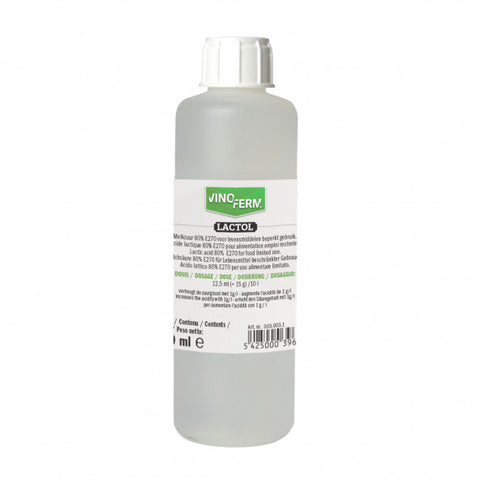
Vinoferm Lactol Lactic Acid 80% 250 ml (E270) - Acidity Corrector for Wine, Must, Mash pH & Sour Beer
Black Friday rush: we ship as fast as we can, but delivery may take 1–2 days longer than usual.
The soft acid. Lactic acid lowers pH with a rounder, milkier edge than citric or tartaric — the acidity of yoghurt rather than lemon — which makes it the winemaker's choice for correcting a flat must and the brewer's go-to for mash pH in all but the most delicate lagers. Vinoferm's dose is exact: 12.5 ml (15 g) per 10 L raises total acidity by 1 g/L. In a mash, a few millilitres bring a pale grist into range; in a kettle sour it sets the starting pH for lactobacillus.
For mash pH it works like phosphoric acid at slightly more volume (about 1.15× that of 75% phosphoric); the trade-off is a faint lactic note at higher doses, which suits wheat beers, saisons and stouts and can show in a light Pilsner. For wine and cider it is the gentlest way to add backbone without a sharp edge.
80% is corrosive — gloves and eye protection, add to liquid, never the reverse. Measure as you add: a pH meter for beer, acidity titration or taste for wine. Over ~3 ml per 20 L of mash its flavour starts to show.
Key features
- 80% food-grade lactic acid (E270)
- Wine/must: 12.5 ml per 10 L = +1 g/L total acidity
- Mash pH correction for ales, wheat beers, stouts
- Sets pH for kettle sours before lactobacillus
- 250 ml bottle
Usage
- Wine: measure acidity, add 12.5 ml per 10 L per g/L wanted, re-test after a day
- Mash: add half the calculated dose with a pipette, stir, measure after 5 minutes
- Kettle sour: acidify the wort to pH 4.5 before pitching lactobacillus
- Store closed, upright, out of reach of children
Quick facts
- Strength: 80% lactic acid, food grade (E270)
- Volume: 250 ml
- Wine dose: 12.5 ml / 10 L = +1 g/L
Related products
- Phosphoric Acid 75% — the flavour-neutral alternative
- Citric Acid 150 g — the brighter wine acid
- Digital pH Meter — measure as you add
- Lalvin 71B — the yeast that softens acidity further
From the blog
- Brewing Water Chemistry Made Simple — lactic vs phosphoric in the mash