

Ask a homebrewer what goes into their beer and they'll talk about malt, hops, and yeast. They'll rarely mention the ingredient that makes up more than 90% of what's in the glass: water.
For a long time, water was the part of brewing nobody touched. You used what came out of the tap and hoped for the best. But once you understand what's actually dissolved in your water — and how it shapes flavour, clarity, and mouthfeel — you unlock one of the biggest quality jumps available to a home brewer. And unlike a new system or a fancy fermenter, it costs almost nothing.
This guide breaks down brewing water chemistry without the chemistry degree. By the end you'll understand what matters, what doesn't, and how to start adjusting your water with confidence.
Why Water Matters More Than You Think
Historically, the world's classic beer styles were shaped by local water. Pilsner came from Plzeň because the water there is extremely soft — almost mineral-free — which suits a delicate, pale lager. Dublin's hard, carbonate-rich water suited dark, roasty stouts because the alkalinity balanced the acidity of roasted malts. Burton-on-Trent's sulfate-heavy water made its pale ales famously crisp and hop-forward.
None of those brewers were adjusting their water. They simply made the beer that worked with the water they had. Today you can do the opposite — start with a blank canvas and build the right water for whatever style you want to brew.
The Ions That Actually Matter
You don't need to track everything in your water. Six ions do almost all the work:
- Calcium (Ca²⁺) — the workhorse. Helps mash pH, yeast flocculation, clarity, and stability. Most brewing water benefits from 50–150 ppm.
- Sulfate (SO₄²⁻) — accentuates hop bitterness, making it feel crisp and dry. The signature ion of hoppy pale ales and IPAs.
- Chloride (Cl⁻) — enhances malt sweetness, fullness, and body. The signature ion of malty, rounded beers.
- Magnesium (Mg²⁺) — minor enzyme and yeast support. A little goes a long way; too much tastes harsh.
- Sodium (Na⁺) — rounds out malt character in moderation. Too much, especially with sulfate, tastes harsh and salty.
- Bicarbonate (HCO₃⁻) — alkalinity. Resists pH drops in the mash. Good for dark beers, problematic for pale ones.
The One Ratio That Matters Most: Sulfate to Chloride
If you remember only one thing from this guide, make it this. The sulfate-to-chloride ratio is the single most influential lever you have over how your beer is perceived.
- Sulfate-dominant (ratio above ~2:1) → crisp, dry, hop-forward. Ideal for West Coast IPAs and pale ales.
- Balanced (around 1:1) → versatile, suits most styles.
- Chloride-dominant (ratio below ~0.5:1) → soft, full, malty. Ideal for Hazy IPAs, stouts, and malty lagers.
Two brewers can use the exact same recipe and grain bill, and the one who nudges this ratio toward sulfate will get a noticeably sharper, more bitter-feeling beer — even with identical hop additions. It's that powerful. You'll find the salts to control it in our Water Chemistry collection.
Mash pH: The Real Reason to Start
Most brewers come to water chemistry chasing flavour, but the more fundamental benefit is mash pH control.
There's a sweet spot — roughly pH 5.2 to 5.6 — where the enzymes in your mash work most efficiently, where you extract cleanly, and where your finished beer tastes brightest. Land outside that window and you get poor conversion, dull or harsh flavours, and hazy beer.
Your grain bill pushes the pH around — darker, roasted malts pull it down, while pale malts leave it higher. Your water's alkalinity (bicarbonate) is what resists those shifts. The art of water treatment is balancing the two: adding calcium and acid to bring a too-high pH down, or adding bicarbonate to support dark grains that would otherwise crash it too low.
You'll want a way to measure this. A pH meter is the most useful single instrument you can add to your brew day — see our Measurement Tools collection.
Should You Start With RO Water?
Here's the approach a lot of serious home brewers land on: instead of trying to correct tap water — whose profile you may not fully know and which can vary seasonally — you start from near-zero and build up.
Reverse osmosis (RO) water is effectively a blank slate: almost no minerals, no chlorine, no surprises. From there you add exactly the salts your target profile calls for. You know precisely what's in your water because you put it there.
A common practical method is blending — for example, mixing RO water with a small percentage of tap water to keep a little of the mineral base while diluting the alkalinity and any off-flavours. An 80/20 or 85/15 RO-to-tap blend is a popular starting point that gives you control without going fully to the trouble of building a profile from absolute zero.
If your tap water is soft and clean to begin with, you may not need RO at all. If it's hard, heavily chlorinated, or inconsistent, RO blending is the single biggest reliability upgrade you can make.
The Salts and Acids You'll Actually Use
You don't need a laboratory. A handful of inexpensive additives covers virtually everything a home brewer needs:
- Gypsum (calcium sulfate) — adds calcium and sulfate. Your go-to for hop-forward beers.
- Calcium chloride — adds calcium and chloride. Your go-to for malty, full beers. (If your beers clarify poorly on soft water, low calcium is often the culprit — calcium chloride is a great fix.)
- Epsom salt (magnesium sulfate) — small magnesium and sulfate additions.
- Sodium bicarbonate (baking soda) — raises alkalinity to support dark grain bills.
- Acids (lactic or phosphoric) — lower mash pH when needed, especially for pale beers brewed with alkaline water.
Everything on this list is a low-cost consumable that lasts many batches. You can find the full range in our Water Chemistry collection.
A quick note on chlorine and chloramine: if you brew with tap water, treat it for chlorine first (a Campden tablet or activated carbon filtration). Chlorine reacts with compounds during fermentation to produce chlorophenols — a medicinal, plastic-like off-flavour that's one of the most common faults in tap-water homebrew.
Don't Do the Maths by Hand — Use CraftBrew.io
Here's the part that scares people off water chemistry: the calculations. Working out how many grams of each salt to add, across your mash and sparge water, to hit a target profile — by hand — is genuinely tedious and easy to get wrong.
This is exactly what the water calculator in CraftBrew.io is built for. You:
- Enter your starting water (or select RO as a blank base)
- Choose a target profile for your style, or set your own sulfate-to-chloride balance
- Get exact salt additions in grams, calculated for your specific batch and water volumes
- See your predicted mash pH before you've even heated the water
Instead of guessing or wrestling with a spreadsheet, you get a precise, repeatable salt schedule every time — and because it's tied to your recipe, you can adjust the profile and instantly see how it changes the character of the beer. It turns water chemistry from the most intimidating part of brewing into a two-minute step.
Try the water calculator free on CraftBrew.io →
A Simple Starting Point by Style
| Style | Aim For | Lean On |
|---|---|---|
| West Coast IPA / Pale Ale | High sulfate, crisp & dry | Gypsum |
| Hazy / New England IPA | High chloride, soft & full | Calcium chloride |
| Pilsner / Pale Lager | Very soft, low minerals | RO base, minimal additions |
| Stout / Porter | Higher alkalinity for dark grains | Calcium chloride + bicarbonate |
| Amber / Malty Ales | Balanced, chloride-leaning | Calcium chloride, some gypsum |
Treat these as starting points, not rules. Once you can taste the difference your water makes, you'll start dialling in profiles to your own preference — which is exactly when brewing gets really fun.
Where Water Fits in Your Brew Day
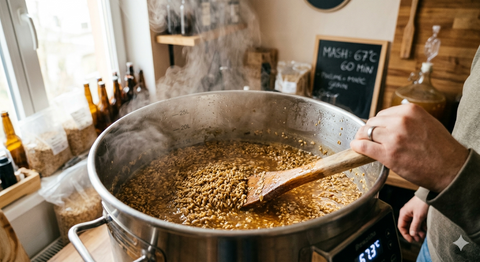
Water treatment happens right at the start — you adjust your brewing water before or as you heat it, ahead of mashing in. If you're still getting comfortable with the all-grain process itself, get the mechanics down first, then layer water chemistry on top once brew day feels routine.
And once you've nailed your water and your mash, the next quality gains come downstream: clean fermentation and good packaging. If you haven't already, our guides on pressure fermentation and kegging your homebrew are the natural next steps.
Final Word
Water chemistry has a reputation for being the most intimidating corner of homebrewing. It isn't. It comes down to a handful of cheap salts, one important ratio, a target pH range, and a calculator to do the maths for you. Get those right and every beer you brew gets cleaner, brighter, and more consistent — using ingredients you can buy for a few euros.
It's the highest-value, lowest-cost upgrade in the hobby. Most brewers wish they'd started sooner.
Not sure where to begin with your own water? Message us on WhatsApp or email — we're brewers too, and water is a bit of an obsession of ours.
Shop brewing salts and acids in the Water Chemistry collection
Calculate your salt additions and mash pH on CraftBrew.io

Comments (0)
There are no comments for this article. Be the first one to leave a message!