
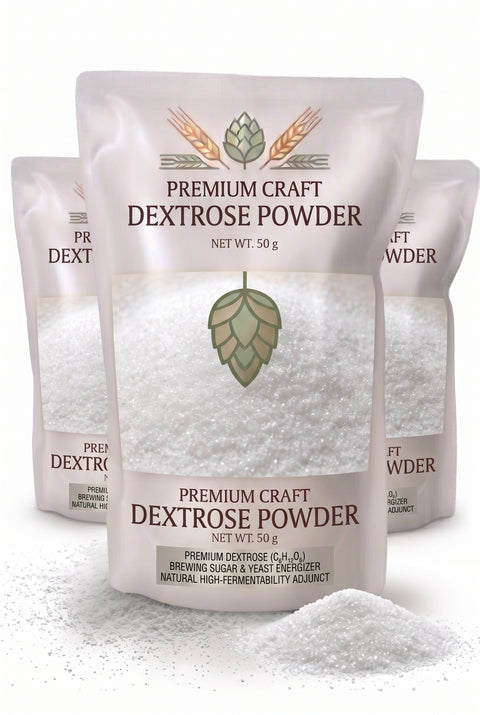
Vinoferm Glucose (Dextrose) - Priming Sugar for Bottle Conditioning & Brewing Sugar for Dry Belgian Ales, 500 g or 1 kg
The sugar every bottling brewer runs out of. Glucose — dextrose, grape sugar — is the simplest sugar there is: yeast ferments it completely and fast, with no residual sweetness and no flavour. That makes it three tools. Priming sugar: 6–7 g per litre of beer gives a normal carbonation in bottles. Gravity booster: up to 15% of the fermentables in a tripel or a Belgian strong golden makes the beer drier and lighter than malt alone could. And starter sugar for mead, cider and kombucha.
It dissolves faster and ferments cleaner than table sugar (sucrose), which yeast has to split first, and it is the honest choice for bottle conditioning: weigh it, boil it in a little water, stir it into the bottling bucket — every bottle carbonates the same.
Weigh priming sugar, never guess: 7 g/L in warm beer can over-carbonate; use a priming calculator with your beer's temperature. Glass bottles only for primed beer; store bottles warm for two weeks, then cool. Keep the bag closed — glucose clumps in humid air.
Key features
- Pure dextrose (glucose), food grade
- 100% fermentable, no flavour, no residual sweetness
- Priming: ≈ 6–7 g per litre for normal carbonation
- Dries out tripels and Belgian strong ales
- 500 g or 1 kg
Usage
- Priming: weigh 6–7 g per litre, boil in 200 ml water, cool, stir into the bottling bucket
- Belgian ales: add up to 15% of fermentables to the boil
- Mead, cider, kombucha: dissolve in warm water before adding
- Store closed and dry
Quick facts
- Contents: dextrose monohydrate, food grade
- Priming dose: ≈ 6–7 g/L
- Packs: 500 g / 1 kg
Related products
- Mangrove Jack's Carbonation Drops 200 g — the pre-dosed alternative
- Brown Candi Sugar — the Belgian sugar with colour
- Twin Lever Capper — cap what you primed
- SafAle BE-256 — the abbey yeast that eats it
From the blog
- Bottle Conditioning Done Right — priming sugar, carbonation and timing