

You’ve spent brew day mashing, boiling, chilling. You’ve watched your airlock bubble for two weeks. And now you’re standing in front of a stack of empty bottles, a capper, and a very tired arm — wondering if there’s a better way.
There is. It’s called kegging, and once you go keg, you rarely go back.
This guide covers everything you need to know to make the switch: what equipment you need, how carbonation actually works, and how to pour your first perfect pint from your own tap.
Why Keg Instead of Bottle?
Bottling works. But it’s slow, repetitive, and introduces more oxygen than most brewers realize. Every bottle is a potential infection point. Every cap is another variable.
Kegging solves most of that in one move:
- Faster packaging - transfer your beer in minutes, not hours
- Less oxidation - a CO2-purged keg is far more oxygen-free than bottles
- Force carbonation - dial in your exact carbonation level instead of guessing with priming sugar
- Easier serving - pour a fresh pint whenever you want, without refrigerating 40 individual bottles
- Cleaner process - fewer surfaces to clean and sanitize
The upfront cost is higher than a bag of bottle caps. But the time and consistency you gain pays it back fast.
Understanding the Kegging System
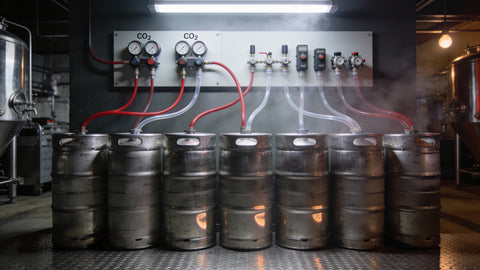
A basic keg setup has four components:
1. The Keg
Most homebrewers use cornelius kegs (a.k.a. corny kegs) - originally used by the soft drink industry and adopted wholesale by the homebrew community. They come in two valve styles:
- Ball lock - slightly slimmer, the most common in homebrew
- Pin lock - older style, a bit wider, still widely used
Standard sizes are 9.5L, 19L, and 23L. Choose based on your typical batch size. A 19L keg is the sweet spot for most 20L batches.
If you want something more compact — like for a birthday party, a barbecue, or just keeping a keg in the fridge - the Brew Monk 4L Mini Keg is a brilliant option. It comes as a complete serving system with an integrated regulator, so it’s essentially plug-and-play.
2. The CO2 Tank & Regulator
Your regulator is what transforms a high-pressure CO2 cylinder into a usable, controlled gas supply. It’s one of the most important pieces of kit in your setup.
A good regulator lets you:
- Set serving pressure (typically 10-12 PSI for most styles)
- Set carbonation pressure (higher, for force carbing)
- Monitor your CO2 tank level
The Kegland Mini 360 Regulator is a popular choice for single-keg setups - compact, reliable, and easy to read. If you’re running multiple kegs off one cylinder, look at dual-gauge or manifold regulators in our regulators collection.
Pro tip: Buy a larger CO2 tank than you think you need. Running out mid-pour is deeply annoying.
3. Beer & Gas Lines
These connect your regulator to your keg (gas-in post) and your keg to your tap (beer-out post). Line length and diameter matter - they affect how much foam you get at the tap.
For a standard kegerator setup at 10–12 PSI, ~2 metres of 3/16” (4.8mm) beer line creates enough resistance to give you a clean pour. Go shorter and you’ll be fighting foam all day.
Browse our Beer & Gas Line collection for the right sizes and lengths.
4. The Tap
Your tap is where all that effort finally meets your glass. The two main types for homebrewers:
- Standard flow faucets - simple, reliable, good for most styles
- Flow control faucets - let you adjust flow rate mid-pour, ideal for high-carbonation beers or anyone running longer beer lines
The NukaTap Flow Control G2 is one of our most popular taps. The integrated flow control makes it forgiving regardless of your line setup, and it’s built to last.
Connecting It All: Fittings
This is the bit beginners often overlook until they’re standing there with mismatched connectors.
The Duotight push-in fitting system is the cleanest way to connect your setup. No hose clamps, no barb fittings, no leaks. Push the line in, it seals. Pull the collar back to release. That’s it.
Our Push In Fittings has everything you need - including inline check valves, unions, and T-pieces for splitting a gas line between multiple kegs.
How to Carbonate Your Beer
This is where kegging gets genuinely better than bottles. You have two methods:
Force Carbonation (Recommended)
Hook up your CO2, set the regulator to the right pressure for your target carbonation level, and wait. That’s it.
A quick reference:
- Low carbonation (1.8–2.0 vol) - ~8–10 PSI at 2°C
- Medium carbonation (2.2–2.5 vol) - ~11–14 PSI at 2°C
- High carbonation (2.6–3.0 vol) - ~14–18 PSI at 2°C
At cold temperatures (near 0–2°C), beers typically reach full carbonation in 5–7 days at serving pressure. If you’re in a hurry, you can “burst carb” at 30 PSI for 24 hours, then drop to serving pressure — though you risk over-carbonation if you’re not careful.
Natural Carbonation Under Pressure
If you’re fermenting in a pressure-capable vessel (like the FermZilla All Rounder you can naturally carbonate by adding a small amount of priming sugar at packaging and sealing the keg. The yeast does the rest.
This method produces finer, more persistent carbonation - similar to a bottle-conditioned beer. The Duotight BlowTie Spunding Valve lets you set a pressure ceiling during fermentation so the naturally produced CO2 stays in solution rather than venting away.
Cleaning & Sanitising Your Keg
A keg is easy to clean. But it must be done properly, every single time.
After each batch:
- Release any remaining pressure
- Disassemble the posts and poppets
- Rinse with hot water to remove any beer residue
- Fill with a PBW or Oxi cleaner solution, soak for 20–30 minutes
- Rinse thoroughly
- Fill with Star San or Chemipro San no-rinse sanitiser, slosh around, drain
- Pressurize with a little CO2 to keep it sealed until use
Browse our Cleaners & Sanitisers collection - we stock everything from PBW to Star San to full brewery cleaning kits.
> Don’t forget to clean the posts and dip tubes. They’re small, but they’re in contact with your beer every single pour.
Tracking Your Kegged Beer in CraftBrew.io
Once your beer is in the keg, the brewing isn’t really over - it’s aging, carbonating, potentially lagering. CraftBrew.io lets you log your batch all the way through to the keg:
- Record your original gravity, final gravity, and ABV
- Follow up in real time what is happening and what will happen next with your beer
- Note your carbonation target and actual CO2 volumes
- Set a “ready to drink” date as a reminder
- Track how long the keg lasts (useful data for planning your next batch timing)
If you’re running multiple kegs at once - which happens faster than you’d expect - the platform helps you keep track of what’s on tap, what’s conditioning, and what needs brewing next.
Sign up free at CraftBrew.io
What to Buy First: A Starter Keg Setup
If you’re starting from scratch, here’s a solid entry-level setup:
| Item | Link |
|---|---|
| Cornelius Keg (19L Ball Lock) | Kegs & Parts |
| Kegland Mini 360 Regulator | Regulators |
| CO2 cylinder (2kg) | CO2 & Accessories |
| Beer line + gas line (2m each) | Beer & Gas Line |
| NukaTap Flow Control G2 | Taps & Accessories |
| Duotight push-in fittings | Fittings & Connectors |
Or if you want to start smaller before committing to a full kegerator: the Brew Monk 4L Mini Keg Serving System is a complete, self-contained unit that gets you pouring your first kegged homebrew without building out a whole dispensing setup.
Final Pour
Kegging isn't complicated — it just feels that way at first because there are more parts than a bottle capper. Once you've done it once, the process becomes second nature. And honestly? Pulling a fresh pint of your own beer from your own tap, perfectly carbonated, crystal clear, no sediment — it's one of those brewing moments that makes the whole hobby feel completely worth it.
Got questions about which setup is right for your situation? Drop us a message via WhatsApp or email — we're brewers too.
Browse all dispensing gear at craftbrew.nl/collections/taps-accessories
Build your recipe and track your keg on CraftBrew.io

Comments (0)
There are no comments for this article. Be the first one to leave a message!