
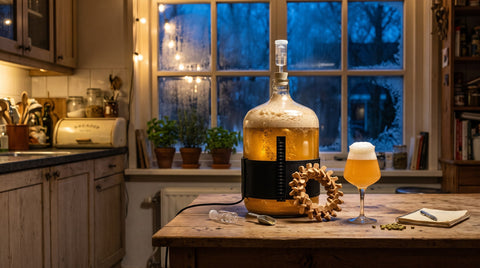
Most ale yeast starts sulking above 22 °C. Push it to 30 and you get solvent, fusels and a headache in a glass. Kveik laughs at that. Pitch it into wort at 35 °C and it eats the sugar in two or three days, drops bright, and leaves you juicy orange or pineapple instead of hot-alcohol burn.
That makes kveik the most forgiving yeast you can buy — and the fastest route from brew day to a full glass. No fermentation fridge, no cooling, no two-week wait. If you've only ever brewed with "normal" ale yeast, this is the guide that changes your schedule.
What kveik actually is
"Kveik" is simply the dialect word for yeast on Norway's west coast — the farm country between Hardanger and Sunnmøre. It comes from the Old Norse word for lively, and it fits. For generations, farmhouse brewers there kept their own yeast from brew to brew, and when a culture went bad they borrowed a fresh one from the neighbouring farm. Modern brewing pushed most of that tradition aside — but a handful of farms kept their cultures alive.
The beer writer Lars Marius Garshol tracked many of those cultures down and logged them in his Farmhouse Yeast Registry, and the brewing world took notice. When researchers sequenced them in 2018, kveik turned out to be a genetically distinct family of brewing yeast — related to the ale strains you know, but at home at temperatures that would stress them.
Most kveik cultures are multi-strain: not one yeast but a small team that has evolved together on a single farm. That's part of why they're so robust — and why each farm's kveik tastes different.
Why homebrewers love it
- Heat is a feature, not a fault. Kveik ferments cleanly from the high 20s right up to around 40 °C. Below the mid-20s it slows down and gets more neutral.
- Speed. In the low-to-mid 30s, a normal-strength beer is often done in 2–4 days. Your gravity readings decide, not the calendar.
- It drops clear. The cultures we stock are highly flocculent — they settle fast and firm.
- Small pitch, big job. One 7 g sachet does a full 23 L batch. No starter, no rehydration drama — sprinkle it on warm wort.
- No fermentation fridge needed. In summer, room temperature is already in range. In winter you need a little heat, not a cooling setup — far cheaper.
Voss vs Stalljen: which kveik do you want?
We stock two organic kveik cultures from Kveik Yeastery. Both come in 7 g sachets, one per 23 L batch.
| K.1 Voss | K.22 Stalljen | |
| Origin | Voss, western Norway — the culture of farmhouse brewer Sigmund Gjernes | Hornindal, Norway — from Stig Seljeset; named after the farm's old horse stable |
| Temperature range | 15–40 °C | 12–38 °C |
| Flavour | Orange, tangerine, citrus | Pineapple, mango, lemon, orange |
| Attenuation | High — finishes drier | Medium — leaves a bit more body |
| Alcohol tolerance | 13% | 12% |
| Best for | Pale ale, IPA, farmhouse ale — and anything you want fast and crisp | Hazy IPA, juicy pale ale, and kveik "pseudo-lager" |
Short version: Voss if you want citrus and a dry finish. Stalljen if you want tropical fruit and a softer, rounder beer — and if you want to try a kveik lager-alike at the cool end of its range.
Keeping it hot in a Dutch winter
Here's the catch: in November your garage is 12 °C, your hallway 17. Kveik will still ferment at the cool end, but you lose the speed and most of the fruit. You want the beer itself in the low 30s, and you want it to stay there overnight. Three pieces of kit make that easy:
1. Heat. A 30 W heating belt or the wider 30 W heating wrap around the lower half of the fermenter, or an Inkbird 25 W heating pad underneath it.
2. Control. Plug the heater into an Inkbird ITC-308 WiFi controller and tape the probe to the side of the fermenter under a bit of insulation — you're controlling the beer, not the air. Set 32 °C and walk away.
3. Insulation. A fermenter in a cold room loses heat faster than a small heater can add it. Zip it into a Cool Brewing bag — it keeps heat in just as well as it keeps it out — or at least wrap it in an old blanket. Active kveik makes some heat of its own; insulation lets you keep it.
Pro tip: in a really cold space, don't chase 38 °C. Holding a steady 30–32 °C gives you most of the speed and fruit, and steady beats hot every time.
Recipe: the "Ready by Christmas" kveik hazy pale
A soft, juicy pale ale around 5% — and the reason we're writing this in November. Brew it on the first weekend of December, and it's carbonated in the fridge well before the 25th.
Batch: 23 L · OG: about 1.050 · ABV: about 5% · calculated at roughly 72% brewhouse efficiency — adjust the base malt to your system.
- 4.0 kg Weyermann Pale Ale malt
- 0.6 kg Weyermann Wheat Malt Pale
- 0.6 kg flaked oats — the silky body and haze
- Whirlpool, 20 minutes at 80 °C: 25 g Citra Cryo + 25 g Mosaic Cryo. No 60-minute bittering addition — the whirlpool alone gives a soft, rounded bitterness.
- Dry hop on day 2: another 25 g of each
- Yeast nutrient: one sachet of Mangrove Jack's Beer Nutrient in the last 10 minutes of the boil. Kveik works hard and fast — feed it.
- Yeast: one sachet of K.22 Stalljen for tropical and soft, or K.1 Voss for orange and dry
That's four 25 g Cryo bags in total — enough for 15% off with the Yakima Chief Cryo & T90 mix & match.
Mash at 67 °C for 60 minutes. We'll crush the malt for you if you order it crushed.
The kveik schedule, day by day
Brew day (Saturday). Chill only to about 32 °C — no need to fight your chiller down to 18. Sprinkle the yeast straight onto the wort, close up, heater and controller on. At these temperatures kveik gets going fast — don't be surprised by a busy airlock the same evening.
Day 2 (Monday). Fermentation is roaring or just past its peak. This is your dry-hop moment — adding hops while the yeast is still active scrubs oxygen and gives you that juicy biotransformation character. Our dry hopping guide covers timing and dosing in detail.
Day 3–4. Take gravity readings a day apart. Same number twice means it's done — a hydrometer does the job, a RAPT Pill shows you the curve flattening (and the beer temperature) on your phone without opening anything.
Day 5. Heater off, cold crash if you can. Kveik drops fast.
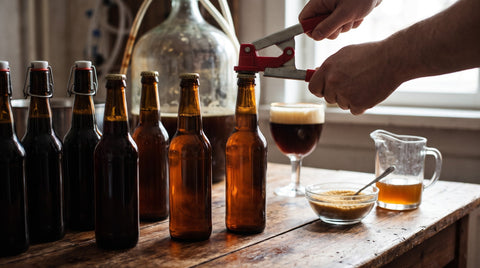
Day 6–7. Keg and force-carbonate, and you're pouring a week after brew day. Not kegging yet? Our kegging guide walks you through it — or bottle-condition and add two weeks.
Start small: the Voss vs Stalljen side-by-side
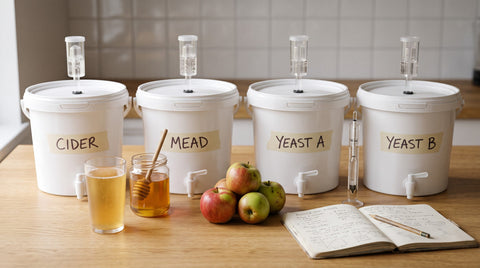
The best way to learn kveik is to taste both cultures on the same wort. Brew about 9 L of the recipe above — roughly 1.6 kg pale ale malt, 250 g wheat malt, 250 g flaked oats and 10 g of each hop in the whirlpool — and split it over two 5 L fermentation buckets, about 4.5 L each. Leave that headspace: kveik throws a big krausen.
Pitch Voss in one bucket and Stalljen in the other — a whole sachet per bucket is more than enough. Give each bucket its own heating belt, dry hop each with 5 g of both hops on day 2, and pour them side by side a week later. The buckets come with tap, lid and airlock, so the fermenter side is sorted — and a 5 L bucket fits on a kitchen counter, which is exactly where a cold-garage brewer wants a hot fermentation.
Rather keep it in one vessel? The whole 9 L fits in a 10 L bucket.
Kveik "pseudo-lager"
Kveik's party trick: ferment it at the cool end of its range and the fruit fades into something clean and crisp. Kveik Yeastery recommends Stalljen for exactly this. Use a pilsner-style grist — Weyermann Pilsner malt and a noble hop — and ferment around 20 °C. At 20 °C or below the pack says to double the dose, so pitch two sachets for a 23 L batch.
Want it cleaner still? Ferment under pressure in a FermZilla with a spunding valve. Pressure keeps the fruity esters down and you finish carbonated. Everything you need to know is in our pressure fermentation guide. It won't fool a Bavarian brewmaster, but it'll fool your friends — in a fraction of the time a real lager takes.
Common kveik mistakes
- Pitching cold and staying cold. Kveik at 16 °C is slow and neutral — fine for a pseudo-lager, pointless for a juicy pale. If you want the fruit, get the beer into the high 20s or above.
- Letting it crash overnight. A big temperature drop mid-fermentation can stall it. Insulate, and control the beer temperature, not the room.
- Missing the dry-hop window. Kveik is done before your usual "day 5" habit kicks in. Dry hop on day 2.
- Skipping nutrient. Fast, hot fermentations need nitrogen and minerals. One nutrient sachet costs less than a pint.
- Trusting the calendar. "Done in 3 days" is typical, not guaranteed. Two matching gravity readings, every time.
Let the app keep up with the yeast
Kveik moves so fast that the hard part is knowing where you are. CraftBrew.io predicts your fermentation phases and adjusts as the readings come in — connect a RAPT Pill and you see the gravity drop live, so you know when to dry hop and when to crash. It holds your recipe, brew-day notes and readings on one batch, so your next kveik brew starts where this one ended. Sign up through that link and you get 30 days of Brewmaster free.
What to buy first
A kveik strain (K.22 Stalljen for tropical, K.1 Voss for citrus), yeast nutrient, a 30 W heating belt or heating wrap, a 5 L bucket for test batches or a FermZilla 30 L for full batches, an Inkbird ITC-308 to hold the temperature, Citra Cryo and Mosaic Cryo for the hops, and a hydrometer or RAPT Pill to check it is done. The essentials are in the shop list at the end of this guide.
The rest of the yeast shelf — from US-05 to Belgian and lager strains — is in our Yeast & Nutrient collection.
Final Pour
Kveik turns the rules you learned about fermentation temperature upside down: hot is good, fast is normal, and a fermentation fridge is optional. Give it warmth, a little nutrient and two matching gravity readings, and it gives you a beer in a week that tastes like you waited a month.
Questions about which kveik to pick, or how to keep it warm in your space? Message us on WhatsApp or drop an email — we brew with this stuff ourselves, and we answer fast.
Shop for your kveik brew: Yeast · Malts (whole or crushed) · Hops
More from the blog: Dry Hopping Guide: Cryo vs T90 · Pressure Fermentation Explained · Kegging Your Homebrew


Comments (0)
There are no comments for this article. Be the first one to leave a message!