
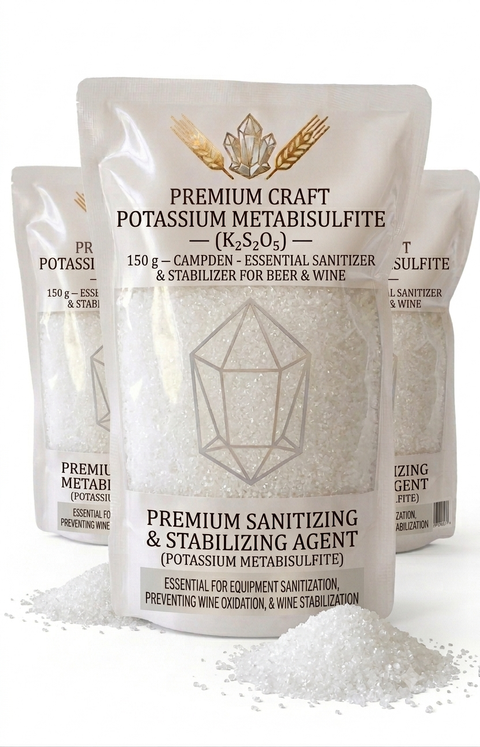
Campden Powder (Potassium Metabisulfite, K₂S₂O₅) - Remove Chlorine & Chloramine, Protect Wine, Cider & Mead, 50–500 g
The powder winemakers and brewers both keep. Potassium metabisulfite releases sulfur dioxide in solution, and that does three jobs. In brewing water it neutralises chlorine and chloramine instantly — the cause of medicinal, plastic, TCP-like chlorophenol off-flavours — at about 0.1 g per 20 L. In wine, cider and mead it stops wild yeast and bacteria in fresh must and protects the finished drink from oxidation. And mixed strong with citric acid it makes a sulphite sanitiser for wine gear.
Campden works by fractions of a gram, not by guesswork: decide your target with a calculator (Bru'n Water, Brewfather, the Grainfather app), weigh the salt on a 0.01 g scale, and add it to the strike water or the mash. Change one thing at a time and taste the difference — a little goes a very long way.
Tiny doses: 0.1 g per 20 L for brewing water, 0.5–1 g per 10 L for wine must — weigh on a 0.01 g scale. Do not pitch yeast into freshly sulfited must for 24 hours. Releases SO₂: do not breathe the dust; sulfite-sensitive people must know it is in the drink.
Key features
- Food-grade potassium metabisulfite (E224)
- Removes chlorine and chloramine from brewing water — no chlorophenol off-flavours
- Protects wine, cider and mead must against wild yeast and oxidation
- Same active as Campden tablets, in weighable powder
- 50 g, 100 g, 250 g or 500 g
Usage
- Brewing water: 0.1 g per 20 L, stir, wait a few minutes before heating
- Wine/cider must: 0.5–1 g per 10 L, wait 24 h before pitching yeast
- At racking or bottling wine: 0.3–0.5 g per 10 L against oxidation
- Store sealed, cool and dry
Quick facts
- Contents: potassium metabisulfite, food grade (E224)
- Water dose: ≈ 0.1 g per 20 L
- Packs: 50 / 100 / 250 / 500 g
Related products
- Citric Acid 150 g — the partner for wine acidity
- Lalvin EC-1118 — the yeast for sulfited must
- 5 L Demijohn Kit — the wine and cider vessel
- Calcium Chloride — the next step in water treatment
From the blog
- Brewing Water Chemistry Made Simple — chlorine, chloramine and how to get rid of them