
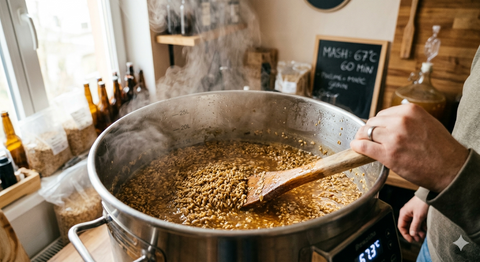
So you've made a few extract kits, or maybe you've just been bitten by the homebrew bug and want to start properly. Either way, you've decided to brew your first all-grain batch.
Good. All-grain is where homebrewing really opens up — full control over your recipe, better beer, and a brew day that's genuinely enjoyable rather than a chore. It can look intimidating from the outside, with talk of mash temperatures and sparging and gravity readings. But it's far simpler than it appears once you've done it once.
This guide walks you through a complete all-grain brew day from start to finish, assuming you've never done it before. No prior all-grain experience needed.
What "All-Grain" Actually Means
In extract brewing, someone else has already converted grain into fermentable sugar for you — you just add the malt extract to water. In all-grain brewing, you do that conversion yourself, by soaking crushed malted barley in hot water. This step is called the mash.
That's the whole difference. All-grain gives you control over the fermentable sugars, the body of the beer, and the flavour in a way extract simply can't. It's also cheaper per batch, because raw malt costs far less than extract.
What You'll Need
The core equipment
Modern all-grain brewing has been transformed by all-in-one electric brewing systems. These combine your mash tun, boil kettle, and pump into a single unit — you mash, sparge, and boil all in the same vessel. They've made all-grain dramatically more approachable than the old three-vessel setups.
You can see the range of systems we stock in our brewing systems collection. For a first-time all-grain brewer, an all-in-one system is the single best investment you can make — it removes most of the complexity and the variables that trip beginners up.
Alongside your system, you'll want:
- A grain mill (or buy pre-milled grain to start) — see our milling systems collection
- A hydrometer or refractometer for measuring gravity — measurement tools
- A fermenter — fermenters collection
- Cleaner and sanitiser — non-negotiable, see cleaning & sanitising
The ingredients
- Base malt + speciality malts — malts collection
- Hops — for bittering, flavour, and aroma — hops collection
- Yeast — dry or liquid — yeast collection
If you're not ready to formulate your own recipe yet, that's completely fine — start by building one in CraftBrew.io, which calculates your grain bill, hop additions, expected gravity, and bitterness for you. More on that below.
Before Brew Day: Plan Your Recipe
Don't wing your first brew. Have a recipe ready, with exact weights and a schedule.
This is where CraftBrew.io earns its place. Build your recipe in the platform and it will:
- Calculate your total grain bill and predicted original gravity
- Work out your hop additions and the resulting bitterness (IBU)
- Tell you your strike water temperature and volumes
- Give you a brew day checklist you can follow step by step
For a first all-grain beer, keep it simple. A single-hop pale ale or a basic amber ale with two or three malts is far more forgiving than a complex recipe. Get the process down first, then get fancy.
Build your first recipe free on CraftBrew.io →
Brew Day: Step by Step
Step 1 — Heat your strike water
Fill your system with your strike water — the mash water volume your recipe specifies (you'll add more later when you sparge). Heat it to your strike temperature, usually a few degrees above your target mash temperature, because adding the cool grain will drop it. Your recipe (or CraftBrew.io) tells you this number. Typically you'll be heating water to around 68–72°C to hit a mash temperature of 65–67°C.
Step 2 — Mash in
Once you're at strike temperature, slowly add your crushed grain, stirring as you go to avoid dry clumps (called "dough balls"). This is mashing in.
Your target is usually a mash temperature of 65–67°C for most beer styles. This temperature range is where the enzymes in the malt convert starches into fermentable sugars.
Step 3 — Hold the mash
Keep the mash at that temperature for 60 minutes. On an all-in-one system, the unit maintains the temperature for you — just let it sit. This is your coffee break.
During this hour, the starches in the grain convert to sugar. By the end, the liquid (now called wort) is sweet.
Step 4 — Mash out & remove the grain
Optionally raise the temperature to around 75°C for a few minutes ("mash out") to lock in your sugar profile and make the wort flow more easily. Then lift the grain basket out of your system and let it drain.
Step 5 — Sparge
Sparging means rinsing the grain with hot water (around 75°C) to extract the remaining sugars clinging to it. Pour or trickle the water through the grain bed slowly. This boosts your efficiency and ensures you're not leaving fermentable sugar behind.
Step 6 — The boil
Now bring your wort to a rolling boil. The boil is typically 60 minutes and does several things: sterilises the wort, drives off unwanted compounds, and — crucially — is when you add your hops.
Hops added early in the boil contribute bitterness. Hops added late contribute flavour and aroma. Your recipe specifies the timing. A simple schedule might be: hops at 60 minutes (bittering), 15 minutes (flavour), and at flameout (aroma).
If you're using a kettle finings agent like Irish moss to help clarity, add it in the last 15 minutes.
Step 7 — Chill the wort
After the boil, you need to cool the wort down to yeast-pitching temperature (usually around 18–20°C for ales) as quickly as possible. A fast chill improves clarity and reduces contamination risk. Many all-in-one brewing systems either include a counterflow chiller or let you recirculate wort through one using the built-in pump — check what your system supports.
Step 8 — Measure your gravity
Take a sample of the cooled wort and measure its original gravity (OG) with your hydrometer or refractometer. This tells you the sugar content and lets you calculate your final alcohol level. Record it — this is the first key data point of your batch.
Step 9 — Transfer & pitch yeast
Transfer the cooled wort into your sanitised fermenter, leaving behind the sludge at the bottom of the kettle (the "trub"). Then pitch your yeast — add it to the wort.
Seal the fermenter, fit an airlock, and move it somewhere with a stable temperature in the right range for your yeast.
Step 10 — Ferment
Now you wait. Fermentation typically takes 1–2 weeks for most ales. You'll see the airlock bubbling within 24–48 hours as the yeast gets to work. Keep the temperature stable — this is the single biggest factor in clean-tasting beer.
After Fermentation: What's Next
Once fermentation is complete (stable gravity readings over a few days), your beer is ready to package. You've got two routes:
- Bottling — see our bottling & filling collection
- Kegging — faster, cleaner, and easier in the long run. We've written a complete guide here: Kegging Your Homebrew: The Complete Beginner's Guide
And if you want to take your fermentation to the next level once you're comfortable with the basics, pressure fermentation is the natural progression — read Pressure Fermentation Explained when you're ready.
Track Your First Brew in CraftBrew.io
Your first all-grain brew day produces a lot of useful data — strike temps, mash temp, OG, fermentation temperature, final gravity. Logging it matters more than beginners realise, because your second brew gets better when you can look back at what your first one actually did.
CraftBrew.io lets you:
- Follow your recipe's brew day checklist step by step
- Record your measured gravities and compare them to predictions
- Track fermentation temperature and progress
- Build a history of every batch so you can refine and repeat your best beers
The brewers who improve fastest are the ones who write things down. CraftBrew.io just makes that effortless.
Beginner Brew Day Checklist
| Stage | What You Need |
|---|---|
| Brewing system | Brewing Systems |
| Crushed grain / mill | Malts · Milling Systems |
| Hops | Hops |
| Yeast | Yeast |
| Thermometer & paddle | Brewing Accessories |
| Hydrometer / refractometer | Measurement Tools |
| Fermenter | Fermenters |
| Cleaner & sanitiser | Cleaning & Sanitising |
Final Word
Your first all-grain brew day will not be perfect, and that's completely fine. You might miss your gravity, your timing might be off, you'll probably make a mess. Every brewer's first batch is a learning experience — and it'll still very likely produce drinkable beer.
The important thing is to start. Keep the recipe simple, follow the steps, write down what happens, and you'll be amazed how quickly it becomes second nature. By your third or fourth batch, brew day will feel like the most relaxing part of your week.
Stuck on what to buy or where to start? Message us on WhatsApp or email — we're brewers too, and we're happy to help you get your first batch going.
Shop everything you need at craftbrew.nl
Plan your recipe and track your brew day on CraftBrew.io


Comments (0)
There are no comments for this article. Be the first one to leave a message!