
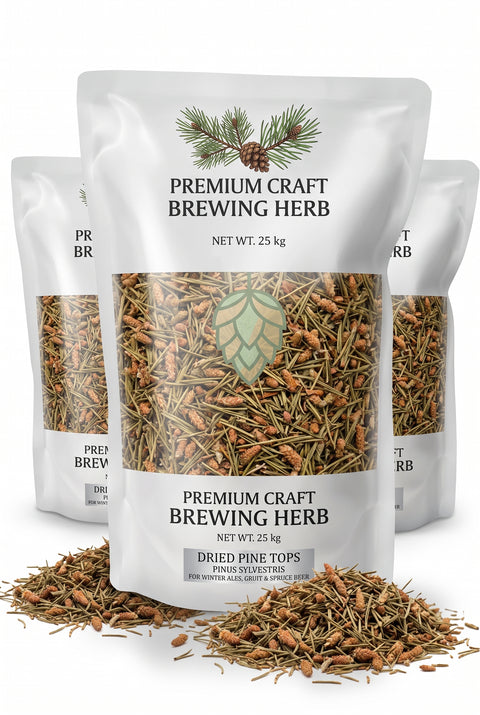
Dried Pine Tops (Dennentoppen) — Pinus sylvestris Brewing Herb for Winter Ales, Gruit & Spruce Beer
Dried pine tops are one of brewing's oldest flavourings — the young tops and buds of the Scots pine (Pinus sylvestris, dennentoppen), picked in spring when their aroma is brightest, and carrying a tradition that runs from medieval gruit ales through Scandinavian farmhouse brewing to the spruce beers that sailed with Captain Cook, who brewed them aboard ship to keep scurvy at bay. Long before hops conquered beer, conifer tips were how northern brewers made it fragrant — and in the glass they still deliver something no hop quite replicates: fresh forest resin, a bright citrus-sap edge, and a clean woodland character that tastes like the air after rain. Open the bag and you'll understand immediately.
Used with a measured hand, pine tops are remarkably versatile. The classic application is the winter and Christmas ale, where 10–25g of dried tops per 20 litres in the final 10–15 minutes of the boil lays a resinous, festive depth under dark malt. The same addition builds a Scottish-style pine gruit — the Alba tradition of brewing with pine and spruce instead of hops — or an authentic northern farmhouse ale alongside juniper and a hot, fast kveik fermentation. Modern brewers run it the other direction too: a modest pine-top charge under a Chinook-hopped IPA stacks botanical pine beneath hop pine, doubling down on the resin theme from two different plants. For maximum control, steep the tops as a strong tea and add the infusion to taste at packaging — the brewer's safety net with any potent botanical.
That measured hand matters: dried tops are concentrated, and conifer character runs from "enchanting forest" to "cough syrup" on a surprisingly short road. Start at the low end, taste, and scale on the next batch — the goal is a beer that hints at the woods, not one that tastes like cleaning product. Beyond the kettle, pine tops earn their shelf space in mead and braggot, gin-style botanical infusions, a resinous forest tea — and the traditional Dutch dennensiroop: simmered with sugar and honey into the pine syrup generations swore by in winter.
⸻
Key Features
- Young dried tops and buds of Scots pine (Pinus sylvestris) — bright, resinous, citrus-edged forest character
- One of brewing's oldest flavourings — gruit, farmhouse, and historic spruce beer tradition
- Winter ale essential: festive resinous depth under dark malt
- Pairs with pine-forward hops for a doubled botanical-plus-hop resin theme
- Tea-infusion method allows precise, taste-as-you-go dosing
- Three sizes: 50g for a batch or two, 100g and 250g for gruit and mead projects
⸻
Usage
Beer: Winter and Christmas ales, pine gruit (Alba-style), Scandinavian farmhouse ales, spruce-style beer, pine-accented IPA and pale ale
Other ferments: Mead, braggot, cider experiments
Beyond brewing: Gin-style botanical infusions, forest tea, traditional pine syrup (dennensiroop)
Dose: Start at 10–25g dried tops per 20L, added in the final 10–15 minutes of the boil — or steep as a tea and blend in to taste. Dried tops are concentrated; begin low and scale next batch. Contain in a muslin bag for a clean kettle.
⸻
Quick facts
Brand: CraftBrew
Botanical: Pinus sylvestris — Scots pine, dried young tops and buds
Also known as: Dennentoppen (NL), Kiefernspitzen (DE), Pin bourgeons (FR)
Type: Brewing herb / botanical
Character: Fresh pine resin, citrus-sap brightness, clean woodland
Pack sizes: 50g, 100g, 250g
Dose: 10–25g per 20L, late boil — or as a tea infusion to taste
Tradition: Gruit, Scandinavian farmhouse, historic spruce beer
Use: Winter ales, gruit, farmhouse, pine IPA accents, mead, infusions
⸻
Related products
- Brewferm Chinook Hop Pellets — pine two ways: botanical resin under hop resin is the double-forest IPA
- Kveik Yeastery K.1 Voss Organic 7g — the Norwegian farmhouse strain this herb's home tradition fermented with
- Organic Cotton Muslin Hop Bag 170×230mm — keeps the tips contained and the kettle clean
- Vinoferm Glucose 1kg — historic spruce beer was conifer tips fermented on simple sugar; the tradition still works
- Pauls Malt Maris Otter — the rich base a resinous winter ale deserves