
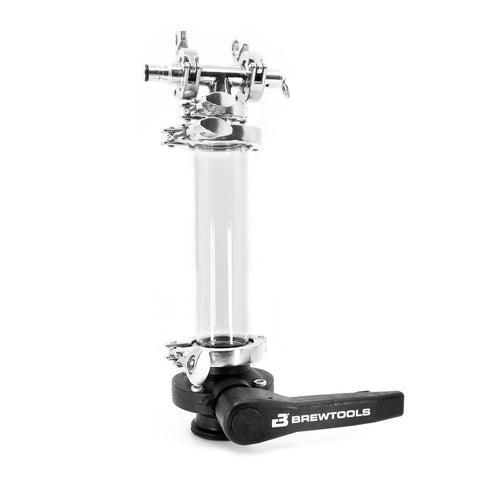
Brewtools HopDrop Kit 2" - Dry Hop a Pressurised Tank Without Oxygen or Pressure Loss, CO₂-Purged Hop Canister
Sold out
Ask us on WhatsAppBlack Friday rush: we ship as fast as we can, but delivery may take 1–2 days longer than usual.
Dry hopping is the weak point of pressure fermentation: open the tank and you dump the CO₂ you spunded, let oxygen in over the beer at its most vulnerable moment, and often get a foaming eruption. The HopDrop fixes it. It is a sealed hop chamber that mounts above a 2" TC butterfly valve on the fermenter: load the hops with the valve closed, seal the chamber, purge it with CO₂ through the gas connection, equalise with the tank — then open the valve and the hops drop into the beer.
Close the valve and the tank never knew it happened: no oxygen, no lost pressure, no hop magnets or dangling bags. Load the next charge the same way for a second dry hop.
Needs a 2" TC port with a butterfly valve on the fermenter and a CO₂ supply with a gas disconnect for the purge. Pellets drop best; leaf hops can bridge in the chamber.
Key features
- Sealed hop chamber for a 2" TC port
- Dry hop under full pressure — no oxygen ingress
- CO₂ purge before the drop
- Repeatable for multiple dry-hop charges
- Stainless Tri-Clamp construction
Usage
- Mount on the fermenter's 2" TC butterfly valve
- Load pellets with the valve closed; seal the chamber
- Purge with CO₂ and equalise to tank pressure
- Open the valve to drop; close it and remove for the next charge
Quick facts
- Connection: 2" Tri-Clamp
- Use: pressure dry hopping
- Purge: CO₂ via gas connection
- Brand: Brewtools
Related products
- Brewtools Butterfly Valve TC 2" — the valve it sits on
- Brewtools MiniUni Pressure Kit 2.0 — pressure top for the MiniUni
- Yakima Chief Citra Cryo — pellets that drop clean
- Brewtools Tri Clamp 2" — one per joint
From the blog
- Dry Hopping Guide — timing and technique
- Pressure Fermentation Explained — why oxygen-free matters