
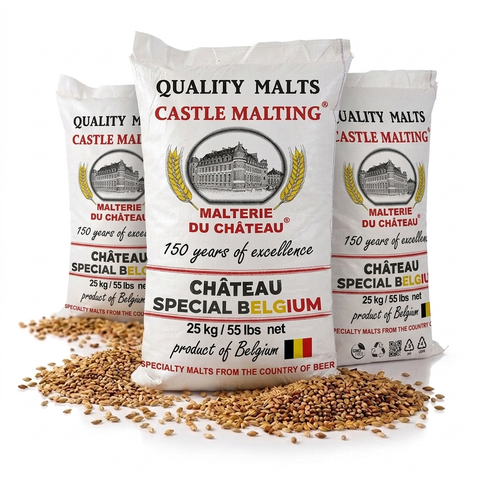
Castle Malting Chocolate Malt 900–1100 EBC - Belgian Chocolate Malt for Porter & Brown Ale
Castle Malting Chocolate is the classic chocolate malt from Belgium's most storied maltster — Castle Malting, whose heritage in Beloeil reaches back to 1868, making it one of the oldest malting houses in the world. Roasted to 900–1100 EBC, this is the grain that gives Porter its name-defining character: deep cocoa, smooth coffee, and a warm nuttiness that no other dark grain delivers with the same roundness. No actual chocolate involved — just malted barley roasted to the exact point where the flavour earns the name.
The word doing the work here is malted — and it's what separates chocolate malt from its darker neighbours. Because the barley is fully malted before roasting, Chocolat malt develops a smoother, sweeter, rounder roast character than unmalted roasted barley's dry snap, and it stops well short of black malt's espresso intensity. The result in the glass is the mellow, dessert-leaning end of the roast spectrum: milk-chocolate and mocha notes, a soft coffee undertone, gentle nut, and deep brown colour with ruby highlights — roast you can taste without roast that bites. That's why chocolate malt is the signature grain of Porter and Brown Ale, where the roast should seduce rather than assert, and a beloved supporting player in stouts, dunkels, and dark Belgian ales.
A quick map of your dark grain choices, because they're picked between as often as blended: Chocolat malt (900–1100 EBC) for smooth cocoa-coffee roundness — Porter and Brown Ale territory; roasted barley (1400–1600) for the dry, sharp Irish stout snap and pale head; black malt (1300–1400) for jet-black colour and clean espresso intensity. Chocolat is the gentlest and most flavour-forward of the three. Dose at 2–8% of the grain bill for classic Porter and Brown Ale depth — a little carries far — and push toward 10% only when chocolate should genuinely dominate. Being fully roasted, it brings no enzymes and needs no conversion: equally at home mashed in an all-grain grist or steeped by extract brewers.
Crushed or uncrushed malt
Available crushed or uncrushed. Crushed malt should be used within 2–3 weeks for optimal freshness. Uncrushed malt retains full freshness for significantly longer when stored in a cool, dry environment.
⸻
Flavor & Aroma
- Smooth cocoa and milk-chocolate roast (signature)
- Soft coffee and mocha undertones
- Warm nuttiness — round, never sharp
- Deep brown colour with ruby highlights
⸻
Usage
Dark Ale: Porter, Brown Porter, Brown Ale, Dark Mild, Old Ale
Stout: Oatmeal Stout, Sweet Stout, Imperial Stout (blended with roasted barley)
Belgian: Dubbel, Belgian dark and festive ales
Lager: Dunkel, Schwarzbier (for a softer take)
Typical usage rate: 2–8% of the grain bill; up to ~10% for chocolate-dominant beers. No mash conversion required — suitable for steeping in extract brewing.
⸻
Quick facts
Brand: Castle Malting (Beloeil, Belgium, heritage to 1868)
Type: Chocolate malt — roasted malted barley
Colour: 900–1100 EBC
Enzymes: None — no conversion required, steepable
Usage rate: 2–8% of grain bill (up to ~10%)
Use: Porter and Brown Ale signature grain, cocoa-coffee roast, dark colour with ruby glow
⸻
Related products
- Pauls Malt Maris Otter — the rich English base a proper Porter is built on; Maris Otter plus chocolate malt is Brown Porter in two lines
- Castle Malting Special Belgium — same maltster, darker caramel: the raisin-and-toffee bridge for Dubbel and dark Belgian grists
- Dingemans Oat Malt MD 4.0 EBC — chocolate malt over silky oats is the chocolate oatmeal stout blueprint
- Fuggles Hop Pellets — the earthy English hop Porter has always worn
- LalBrew Nottingham Dried Yeast 11g — the clean, high-flocculation English strain that lets the cocoa lead